certifications
Lakadong Turmeric Certifications Explained: GI Tag, Organic, GMP, and Export Compliance
17 July 2026
Quick answer: Lakadong turmeric can carry up to four distinct certifications — a Geographical Indication (GI) tag confirming origin, organic certification confirming production method, GMP certification confirming facility standards, and Halal certification where relevant — plus a set of mandatory export documents that apply regardless of certification status. None of these substitutes for another, and understanding what each one actually proves (and doesn’t) prevents buyers from either over-paying for certification that doesn’t matter to their market or under-documenting a shipment that needs it.
Why Do Buyers Confuse These Certifications?
Certification labels get compressed into a single idea of “verified quality” in casual sourcing conversations, but each certification covering Lakadong turmeric answers a genuinely different question. A GI tag answers “where is this from.” An organic certificate answers “how was this grown and processed.” A GMP certificate answers “was this facility run to a documented hygiene and process standard.” A Halal certificate answers “was this handled in a way consistent with Islamic dietary law.” None of them answers “does this specific batch meet my curcumin, heavy metal, and pesticide specification” — that question is answered by batch testing, covered in our companion guide on quality specifications by market.
Buyers who treat any one certification as a stand-in for the others end up either requesting certifications irrelevant to their actual regulatory need, or missing one that is genuinely required for their market.
What Does the Geographical Indication (GI) Tag Certify?
A Geographical Indication tag is a form of intellectual property protection recognised under India’s Geographical Indications of Goods (Registration and Protection) Act, 1999, and, at the international level, under the framework established by the World Trade Organization’s TRIPS Agreement. Lakadong turmeric received GI registration recognising its origin in the Jaintia Hills region of Meghalaya.
What the GI tag certifies: that the product genuinely originates from the registered geographic region and is associated with the reputation, characteristics, or production methods tied to that region.
What the GI tag does not certify: the curcumin content, heavy metal levels, pesticide residue status, organic status, or any other quality or safety parameter of a specific shipment. A GI-tagged batch can still fail a quality specification; the tag speaks only to origin, not to batch-level composition.
For buyers, the practical use of a GI tag is as one input into supplier and origin verification — alongside, not instead of, the checks covered in our authenticity verification guide. Ask suppliers claiming GI-registered Lakadong turmeric to provide supporting documentation tracing the specific consignment back to registered growers or a registered producer group in the Jaintia Hills region, not simply an assertion of origin on a product label.
What Does Organic Certification Actually Require?
Organic certification is a production-method certification, not a quality or safety certification. It confirms that the crop was grown and the material was processed without the prohibited synthetic inputs defined by the relevant organic standard, and that the certification chain — from farm to final packaging — has been audited and documented without a break.
The certification requirements differ meaningfully by destination market:
EU Organic (Regulation 2018/848): Requires certification by a body recognised under the EU’s equivalence or compliance framework, and requires a valid transaction certificate for each batch moving through the supply chain, not just a facility-level certificate.
USDA National Organic Program (NOP): Requires certification by a USDA-accredited certifying body and, since 2024, compliance with the Strengthening Organic Enforcement (SOE) rule, which tightened import certificate and traceability requirements across the organic supply chain.
India Organic / NPOP: The domestic Indian organic standard, administered under the National Programme for Organic Production. An NPOP certificate alone does not automatically satisfy EU or USDA organic requirements; equivalence arrangements and additional documentation may apply depending on the specific import pathway.
For buyers who do not intend to make an organic claim on their finished product, organic certification is not a requirement and adds cost without a corresponding commercial benefit. For buyers who do intend to market an organic claim, the certification must match the specific claim and market being made — an NPOP certificate is not interchangeable with an EU Organic or USDA NOP certificate without the appropriate equivalence documentation in place.
What Does GMP Certification Cover, and How Is It Different from Quality Testing?
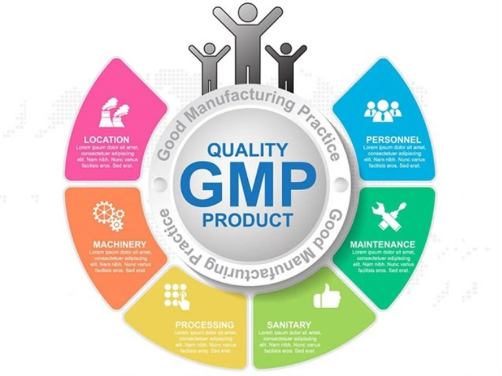
Good Manufacturing Practice (GMP) certification assesses the facility where Lakadong turmeric is processed — washing, drying, grinding, and packaging — against a documented standard covering hygiene controls, equipment maintenance, staff training, pest control, and record-keeping. Common frameworks referenced by Indian herbal ingredient processors include WHO-GMP and ISO 22000.
GMP certification is facility-level and time-bound (typically requiring periodic re-audit), not batch-specific. This is the key distinction from quality testing: a GMP-certified facility provides confidence in the consistency and hygiene of the production environment, but it does not test or guarantee the curcumin content, contaminant levels, or microbial status of any individual batch that facility produces. A facility can be fully GMP-compliant and still produce an individual batch that fails a heavy metal or pesticide specification due to raw material variation upstream of the facility itself.
Buyers should use GMP certification as a baseline supplier qualification criterion — a facility without it presents materially higher risk — and should not treat it as a substitute for the batch-specific testing covered in our quality specifications guide.
When Does Halal Certification Apply?
Halal certification confirms that a product’s handling, processing, and any relevant inputs comply with Islamic dietary law. For a raw botanical material like turmeric, this generally concerns cross-contamination controls and the absence of non-Halal processing aids, rather than the plant material itself, which is inherently Halal-compliant in its unprocessed form.
Halal certification is most frequently requested for UAE and GCC-bound shipments, but demand is not exclusive to that region — Malaysia and Indonesia in Southeast Asia maintain their own significant Halal certification frameworks (JAKIM in Malaysia, MUI/BPJPH in Indonesia), and some buyers in Western markets serving Muslim consumer segments request Halal certification independent of destination region. Buyers should determine the need for Halal certification based on their own downstream market and customer base, not assume it is relevant only to one geography.
Our article on JAKIM halal and Lakadong turmeric in Malaysia and Indonesia goes further.
Which Documents Are Mandatory Regardless of Certification Status?
Separate from the certifications above, a defined set of export documents applies to essentially every Lakadong turmeric shipment regardless of whether any optional certification is held:
Phytosanitary certificate. Issued by India’s Directorate of Plant Protection, Quarantine and Storage (DPPQS), required by the plant quarantine or biosecurity authority of nearly every importing country for plant-based material.
Certificate of Origin. Required by most destination customs authorities and, where a preferential trade agreement applies, necessary to claim reduced duty treatment.
FSSAI registration. Mandatory under Indian domestic law for the exporting entity, independent of the destination market’s own requirements.
Certificate of Analysis. While not always a government-mandated document in the way a phytosanitary certificate is, in practice a CoA is required by virtually every commercial buyer and by many customs and food safety authorities as supporting evidence of compliance with import limits.
For a complete walkthrough of these mandatory documents and how to evaluate them, see our CoA, MSDS, and phytosanitary certificate guide.
How Does This Fit with Our Other Lakadong Guides?
This guide covers what each certification proves and which apply to which markets. It does not cover batch-specific testing requirements — see our quality specifications by market guide for that. It does not cover curcumin content verification specifically — see our curcumin content and HPLC testing guide. It does not cover origin authenticity fraud — see our authenticity verification guide. Together, these four guides form a single quality and compliance reference set for Lakadong turmeric sourcing.
How Ayris Global Supports Certification Verification
Ayris Global works with Lakadong turmeric suppliers across GI-registered, organic, GMP-certified, and Halal-certified production, and helps buyers determine which certifications are genuinely required for their specific destination market and product claim — rather than defaulting to the most expensive certification bundle a supplier offers. We verify certification documentation and its currency before any supplier introduction.
To discuss which certifications apply to your target market, contact our sourcing team at sourcing@ayrisglobal.in or on WhatsApp at +91 97292 56621.
Frequently Asked Questions
What does the Lakadong turmeric GI tag actually certify?
A Geographical Indication (GI) tag certifies that a product originates from a specific geographic region and possesses qualities or a reputation attributable to that origin. For Lakadong turmeric, the GI tag certifies geographic origin in the Jaintia Hills region of Meghalaya — it does not certify curcumin content, organic status, or any specific quality parameter of an individual batch. Those require separate testing and certification.
Is organic certification required to export Lakadong turmeric?
No. Organic certification is required only if the buyer intends to market the product with an organic claim in a market that regulates that claim, such as under EU Regulation 2018/848 or the USDA National Organic Program. Conventional (non-organic) Lakadong turmeric can be exported to any of the nine markets without organic certification, provided it meets the applicable quality, safety, and phytosanitary requirements for that market.
What is the difference between GMP certification and quality testing?
GMP (Good Manufacturing Practice) certification assesses the processing facility — its hygiene controls, equipment, documentation systems, and process consistency. Quality testing assesses the specific batch of product — its curcumin content, heavy metal levels, pesticide residues, and microbial counts. A GMP-certified facility can still produce a batch that fails quality testing due to raw material variation, and a non-GMP facility can occasionally produce a batch that passes testing. Buyers should require both: facility-level GMP certification as a baseline supplier qualification, and batch-level testing as ongoing verification.
Which certifications are mandatory versus optional for Lakadong turmeric exports?
Mandatory documentation for essentially all markets includes a phytosanitary certificate from India’s plant quarantine authority and, for most destinations, a Certificate of Origin. FSSAI registration is mandatory for the Indian exporter under domestic law. GMP certification, organic certification, Halal certification, and the GI tag are not legally mandatory for export in most markets but function as commercial differentiators or are required contractually by specific buyers or for specific market claims.
Does Halal certification apply only to UAE and GCC buyers?
Halal certification is most commonly requested by UAE, GCC, and other Muslim-majority markets, but it is not exclusively a GCC requirement — buyers in Southeast Asia (notably Malaysia and Indonesia) and in some Western markets serving Muslim consumer segments also request Halal-certified botanical ingredients. Buyers should treat Halal certification as a market-driven commercial requirement determined by their own customer base and destination country, not assume it applies only to one region.
Ayris Global connects international buyers across the EU, UK, USA, UAE, Japan, South Korea, Australia, Southeast Asia, and Latin America with verified Indian producers of botanical extracts, herbal powders, and Ayurvedic ingredients, including Lakadong turmeric from Meghalaya. We operate on a commission-only model — no retainer, no markup on goods. Contact our sourcing team to verify certification requirements before your next order.