sourcing
Turmeric Private-Label and Contract-Manufacturing Readiness by Trading Structure: What Auction-Mandi and Cooperative Origins Can Actually Support
6 July 2026
A brand ready to move from raw turmeric sourcing into a private-label or contract-manufactured product line faces a question neither of our existing guides answers directly. Our contract manufacturing guide covers the regulatory and MOQ landscape for finished dosage forms generically, across all Indian herbal ingredients. Our Lakadong private-label guide covers brand positioning and sourcing structure for one specific origin. Neither addresses what this guide covers: how an origin’s trading structure, auction-mandi or cooperative, shapes whether it can actually support a private-label or contract-manufacturing programme at the stage a given brand is at.
For more on this, see sourcing herbal tea for your own label.
Quick answer: Auction-mandi origins (Erode, Salem, Nizamabad) generally offer stronger packaging-format flexibility and volume scalability for a growing private-label programme, but weaker default batch-level traceability, which matters for origin-story or provenance claims. Cooperative origins (Lakadong, increasingly Sangli) generally offer stronger traceability and a defensible origin narrative, but a bounded seasonal volume ceiling and less mature local processing infrastructure, which matters for a programme planning to scale contract-manufactured volume quickly. The right fit depends on which constraint - traceability or volume flexibility - the specific programme depends on more.
Readiness Is a Different Question From Regulatory Compliance
Our general contract manufacturing guide covers what any Indian finished-product manufacturer needs regardless of ingredient: AYUSH or FSSAI licensing, WHO-GMP certification, HS 3004 documentation. Those requirements apply the same way whether the turmeric behind the product comes from Erode or Lakadong. What they do not cover is a separate, upstream question a brand needs to answer before it even selects a contract manufacturer: does the raw material’s trading structure actually support the volume, traceability, and packaging flexibility the planned programme needs.
This matters because, as our MOQ and packaging economics guide and trading structure guide both describe, auction-mandi and cooperative origins behave differently on exactly the dimensions a private-label programme cares about most: can the origin supply a small pilot batch and then scale, and can the origin document its batches well enough to support an origin-story claim on the finished product’s packaging.
Planning a private-label or contract-manufactured turmeric product and unsure which origin fits your growth plan? Ayris Global can map your programme’s volume and traceability requirements against the right trading structure before you commit to a raw material supplier. Contact our sourcing team
What Readiness Actually Means for This Decision
Three factors determine whether a given origin’s trading structure is ready to support a private-label or contract-manufacturing programme, beyond the raw material’s curcumin grade or price:
Traceability depth. A brand making any origin-story or single-origin claim on finished packaging needs batch-level documentation connecting the raw material used in that specific production run back to a defined origin. This documentation also has to survive the handoff to a contract manufacturer, who is typically located outside the raw material’s growing region.
Volume scalability. A pilot run and a scaled annual programme have very different volume requirements. An origin that can supply a small pilot batch may or may not be able to scale to the volume a successful product needs in its second or third year without a structural change in sourcing.
Packaging and format flexibility upstream of the contract manufacturer. While the contract manufacturer handles final dosage-form packaging, the raw material itself often needs to arrive at that facility in a specific format or lot size. An origin with more flexible bulk packaging, as our packaging economics guide describes, is generally easier to integrate into a contract manufacturer’s intake process without a dedicated changeover.
Auction-Mandi Origins: Volume-Ready, Traceability-Limited
Erode, Salem, and largely Nizamabad exporters, drawing on continuously replenished blended stock from many independent sellers, are generally well positioned to support a scaling private-label programme on pure volume terms. A brand moving from a pilot run to a larger annual order is less likely to hit a hard capacity ceiling sourcing from this trading structure than from a cooperative.
The tradeoff is traceability. Turmeric aggregated through open mandi auction is combined and re-graded across many independent farmers before it reaches an exporter’s blended stock, which makes farm-level or single-farmer-group documentation harder to establish by default. For a private-label brand whose positioning does not depend on a documented single-origin story - a commodity-tier curcumin supplement competing on price and dose, for example - this is not a meaningful limitation. For a brand planning to market a single-origin or provenance-driven claim, sourcing raw material through this trading structure works against the positioning the brand is trying to build.
Cooperative Origins: Traceability-Ready, Volume-Bounded
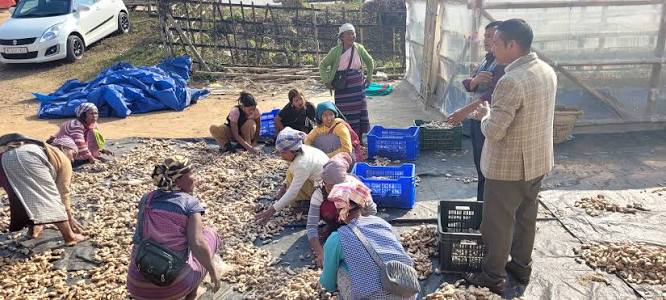
Lakadong, and increasingly Sangli, cooperatives aggregate a defined membership’s seasonal harvest, which generally supports the kind of batch-level, farm-group traceability documentation that underpins a defensible origin-story claim - the same traceability strength our trading structure guide and our Lakadong private-label guide both describe as the basis for GI-tag and single-origin marketing.
The tradeoff is volume and infrastructure. A cooperative’s available supply is bounded by its members’ actual seasonal harvest, which means a private-label programme planning aggressive volume growth needs to confirm the cooperative’s total capacity and current commitment level well before scaling, not after a successful pilot creates demand the cooperative cannot fill. Compounding this, processing infrastructure in northeast India remains less developed than the established manufacturing hubs in Uttarakhand, Himachal Pradesh, or Gujarat where most Indian contract manufacturers actually operate, which means raw material typically has to travel a meaningful distance from the Jaintia Hills to reach a WHO-GMP capsule or tablet facility, adding a logistics and lead-time step that an origin closer to those hubs does not carry.
A related question is covered in where oleoresin and standardized extract are available.
Comparing Readiness Directly
| Factor | Auction-Mandi (Erode, Salem, Nizamabad) | Cooperative (Lakadong, increasingly Sangli) |
|---|---|---|
| Volume scalability for growth | Generally strong - continuous stock replenishment | Bounded by seasonal aggregated harvest |
| Batch-level traceability for origin claims | Weaker by default | Stronger by default |
| Distance to major contract-manufacturing hubs | Shorter for Tamil Nadu and Telangana-based CM capacity | Longer - raw material typically ships to Uttarakhand, Himachal Pradesh, or Gujarat |
| Best fit | Volume-driven, commodity-positioned private label | Provenance-driven, premium-positioned private label at moderate volume |
| Primary risk to manage | Origin-story claims outrunning available documentation | Programme growth outrunning available raw material supply |
Matching Readiness to Programme Stage
Early-stage pilot, provenance-driven positioning. A cooperative origin’s traceability strength is usually worth the volume constraint at this stage, since pilot volumes are unlikely to approach a cooperative’s capacity ceiling, and the origin story is central to differentiating a new product in a competitive category.
Scaling programme, provenance-driven positioning. This is the stage where the cooperative’s volume ceiling becomes a real planning constraint. Brands in this position should confirm the cooperative’s total seasonal capacity and current commitment level directly, and consider whether a second sourcing relationship or a phased volume commitment is needed rather than assuming continuity of supply at growing volume.
Volume-driven, commodity-positioned private label at any stage. An auction-mandi origin generally fits better throughout, since the programme’s competitive basis does not depend on documentation the trading structure cannot easily provide.
What to Verify Before Committing to a Raw Material Origin for a Private-Label Programme
Confirm whether the traceability documentation a cooperative or mandi-based supplier can provide will actually transfer through the contract manufacturer’s own batch records, since a documentation gap at the manufacturing handoff undermines an origin claim regardless of how well the raw material itself was documented. Confirm a cooperative’s current committed and uncommitted volume against your first two to three years of projected growth, not just the initial pilot order. Confirm the logistics and lead-time impact of raw material travelling from origin to contract-manufacturing hub, particularly for Lakadong-to-Uttarakhand or Lakadong-to-Gujarat routes. And confirm which regulatory and certification requirements from our general contract manufacturing guide apply to the specific dosage form and destination market, independent of which raw material origin is chosen.
How Ayris Can Help
Ayris Global works with both auction-trading exporters and cooperative aggregators across India’s turmeric-growing origins, and can help a private-label or contract-manufacturing programme match its volume and traceability requirements to the right trading structure before a sourcing relationship is committed. We operate on a commission-only model - no retainer, no markup on goods.
Frequently Asked Questions
Does a turmeric origin’s trading structure actually matter for a private-label programme, beyond the raw material’s curcumin grade?
Yes. Trading structure determines two things a private-label programme depends on that curcumin grade does not: how well the raw material can be traced back to a specific origin for marketing and compliance purposes, and how much volume the origin can reliably supply as the programme scales. Auction-mandi origins generally support volume scalability better; cooperative origins generally support traceability better.
Is Lakadong turmeric a good choice for a private-label programme planning rapid volume growth?
It depends on the growth trajectory. Lakadong’s cooperative structure supports strong batch-level traceability, which is valuable for an origin-story claim, but its available supply is bounded by the cooperative’s actual seasonal harvest. A programme planning aggressive volume growth should confirm the cooperative’s total capacity and current commitment level well in advance, and should have a contingency plan if growth outpaces what the cooperative can supply.
Why does distance from the raw material origin to the contract-manufacturing facility matter?
Most Indian contract manufacturing capacity for finished herbal capsules and tablets is concentrated in Uttarakhand, Himachal Pradesh, and Gujarat, not in the turmeric-growing regions themselves. Raw material from Lakadong in Meghalaya typically has to travel a meaningful distance to reach these hubs, adding logistics cost and lead time that raw material from Tamil Nadu or Telangana, closer to some manufacturing capacity, does not carry to the same degree.
Can traceability documentation from a cooperative supplier survive the handoff to a contract manufacturer?
It can, but only if the brand confirms this explicitly rather than assuming it. A contract manufacturer’s own batch records need to preserve the link back to the raw material’s documented origin for an origin-story claim to remain defensible on the finished product. Brands should ask both the raw material supplier and the contract manufacturer how batch traceability is maintained across the handoff before finalizing the sourcing arrangement.
Should a brand choose its raw material origin before or after selecting a contract manufacturer?
Generally, a brand should confirm its positioning, provenance-driven or volume-driven, first, since that determines which trading structure fits. From there, raw material origin and contract manufacturer selection should happen together, since the logistics and traceability handoff between the two is easier to plan when both are chosen with the other in mind, rather than locking in a contract manufacturer first and discovering afterward that the preferred raw material origin adds unplanned logistics or documentation complexity.
Further Reading: Herbal Capsule and Dosage-Form Contract Manufacturing from India | Private-Label Nutraceutical and Ayurvedic Products with Lakadong Turmeric | Turmeric Trading Structure Across Origins
Ayris Global connects international buyers across the EU, UK, USA, UAE, Japan, South Korea, Australia, Southeast Asia, and Latin America with verified Indian producers of turmeric and other botanical ingredients, herbal extracts, and finished herbal products. We operate on a commission-only model - no retainer, no markup on goods. Contact our sourcing team to discuss the right sourcing structure for your private-label or contract-manufacturing programme.