certifications
GB vs EU Pesticide Residue Limits for Herbs
6 October 2026
Direct Answer: Great Britain and the EU no longer share one pesticide residue rulebook. GB limits sit in a register kept by HSE and can diverge from EU limits, while Northern Ireland follows the EU. Both use a 0.01 mg/kg default. Check each lot against the register of the market where it will be sold.
A buyer who asks for a pesticide residue limit usually expects one number. For Indian herbal ingredients going to the United Kingdom there are now two rulebooks behind that question. Great Britain keeps its own register of maximum residue levels, the EU keeps another, and Northern Ireland follows the EU. This page explains where they still match, where they can differ, and what a supplier should put on a lot report before it ships to a GB buyer.
It covers the limits themselves, not border checks. Border checks are a separate regime, summarised below and covered in our UK BTOM guide. For the EU side in depth, including inspection history for Indian spices, read our EU compliance guide.
A note on sources: where we could read an official document, the text says so. The section “What We Could Not Confirm” lists the gaps. We give no per-herb limits, because we could not query either register herb by herb.
Same Origin, Two Registers
Regulation (EC) No 396/2005 set one list of maximum residue levels (MRLs) for pesticides in food and feed across the EU. After Brexit it continued in Great Britain as assimilated law, which legislation.gov.uk hosts with amendments that took effect on 31 December 2020. HSE, the Health and Safety Executive, keeps the official record of GB limits, called the GB MRL Statutory Register.
HSE’s guidance makes three points. GB sets MRLs on its own assessments. Existing EU MRLs that were adopted as GB MRLs stay valid until they are amended. And GB and EU MRLs “may become different over time”. The register is organised by part: the products covered, definitive and temporary MRLs by active substance, substances where MRLs do not apply, and default values for substances that are not approved.
For a supplier this is simple to state and awkward to run. The same lot can be compared against two different lists, and a result that passes one list does not automatically pass the other.
How the Default Limit Works on Each Side
Both systems have a catch-all. In the EU text we read, Article 18(1)(b) sets 0.01 mg/kg for products where no specific MRL exists, unless a different default is fixed for a listed substance. In the GB version of the same article, the catch-all is the substance’s default value in Part 5 of the register where one exists, and 0.01 mg/kg where it does not.
So 0.01 mg/kg is the number most people remember, and it is real on both sides. The trap lies in the exceptions. Which substance and crop pairs have a specific limit, and which fall to the default, is decided separately in each register. A residue that has a specific limit in one register can sit under the strict default in the other. We could not check this for individual herbs, so treat it as a reason to check each substance, not as a finding about any herb.
The default also matters for the lab report. A result can only show compliance with a 0.01 mg/kg limit if the method can measure at or below that level. Ask for the limit of quantification for each substance reported, not only a list of what was found.
Why GB Limits Can Sit Above EU Limits
HSE describes one route by which GB and EU limits drift apart: adopting Codex limits. Codex limits (CXLs) are internationally agreed food standards for pesticide residues. HSE assesses which CXLs to adopt and applies three conditions. GB must already set an MRL for that commodity, the existing GB MRL must be lower than the CXL, and no health concern may be identified for UK consumers. Adopted limits are then added to the register. HSE announces adopted batches in its pesticides bulletins, for example one that took effect on 19 March 2024.
Read the conditions closely. The second one means adoption moves a GB limit up toward the Codex level, not down. An advocacy group, PAN UK, published a briefing in April 2025 arguing that a January 2025 batch put many GB limits above their EU equivalents. We could not confirm its figures against the register, so we quote none and treat the briefing as a pointer to look, not as evidence.
The commercial consequence is not that GB is the looser market. It is that no standing rule says which side is stricter for a given pair. A supplier serving both markets should compare substance by substance, and the buyer should say in the specification which register governs.
Northern Ireland Follows the EU
HSE’s guidance for Northern Ireland says EU MRLs apply to food or feed produced in, or imported into and marketed within, Northern Ireland. The exception is GB-sourced goods moved under the Northern Ireland Retail Movement Scheme (NIRMS), set up under the Windsor Framework. Those goods can be marketed in Northern Ireland under GB MRLs even where the EU limit differs. All other goods can only be marketed there if they meet the EU MRL set under Regulation (EC) No 396/2005.
For an Indian supplier the practical question is where the finished goods will be sold, not only where the lot lands. A lot that arrives in Great Britain but ends up in products marketed in Northern Ireland outside NIRMS may need to meet the EU limits. Ask the buyer’s regulatory contact, and ask in writing.
Dried Herbs, Concentration and Processing Factors
Herbal raw materials are usually dried, and drying concentrates whatever residue is present. In the EU text we read, Article 20(1) says that where no specific limit exists for a processed or composite product, the limit follows the raw product, taking into account changes in residue levels caused by processing or mixing. Article 20(2) allows specific factors to be set for particular operations. Our EU compliance guide explains how dehydration factors are applied to dried herbs.
On the GB side, the register overview we read shows the part reserved for processing factors as currently empty. We did not find how GB enforcers treat drying, and we did not read Article 20 as it stands in the GB version. Until that is clear, ask the lab to report each result as measured on the dried material, to state any factor it applied, and to agree in writing with the buyer whether a factor is used when comparing against a limit.
For turmeric in particular, our guide to contaminant baselines by origin shows how buyers write contaminant specifications.
Border Checks Are a Separate Regime
An MRL decides whether a lot may lawfully be sold. Border controls decide how often a consignment is stopped and what paperwork travels with it. They sit in different instruments.
In Great Britain the controls on high-risk food and feed of non-animal origin use assimilated Implementing Regulation (EU) 2019/1793, amended for England by SI 2025/1162 with effect from 1 January 2026. That instrument extends to England and Wales but applies in relation to England only, and we did not check the Scotland and Wales instruments. In the EU, Implementing Regulation (EU) 2019/1793 is amended often: Implementing Regulation (EU) 2026/194 changed it early in 2026, and (EU) 2026/1206 followed in June.
The India entries we saw across these instruments include dried spices such as cumin, nutmeg, mace, cardamom, ginger and turmeric, curry leaves, and moringa drumsticks, listed for pesticide residues. The EU list also carries an entry for food supplements with botanicals. Some entries require an official certificate with laboratory results, and others only raise the share of consignments checked. We give no frequencies, because the EU list changed twice in 2026 alone and we read the tables through summaries, not line by line.
Two cautions follow. Drumsticks are a fresh or frozen vegetable, so a listing for them does not on its face cover dried leaf powder. Which entry applies depends on the commodity code for your product form, so read our moringa powder guide and HS code guide before assuming a list does or does not apply. And before quoting any GB or EU lot, open the current annex for the exact code.
GB and EU at a Glance
- Legal basis: GB uses Regulation (EC) No 396/2005 as assimilated law, with the register kept by HSE. The EU uses the same regulation as the EU has amended it, with limits in the EU pesticides database.
- Default limit: 0.01 mg/kg in both, with substance-specific defaults handled separately in each system.
- Direction of change: limits can be amended on either side independently, and HSE can adopt Codex limits that raise a GB limit.
- Northern Ireland: EU limits, with a NIRMS exception for GB goods.
- Processing factors: set out in the EU text; the GB register part for them is currently empty.
- Border lists: separate instruments, amended on separate timetables.
What a Supplier Should Put in a Lot Report for a GB Buyer
None of this is a reason to hold back a shipment. It is a reason to make the lot report easy to check against the right register. A report that helps a GB buyer includes:
- Substances tested and reporting limits. The full list of active substances in the multi-residue panel, with the limit of quantification for each, at or below 0.01 mg/kg where the method allows.
- Laboratory identity and method. The laboratory name, its accreditation and scope (for example NABL), the method used, and the report date.
- The register used. Which register the results were read against (GB, EU or both) and the date it was consulted.
- Any factor applied. A plain statement of whether a processing or dehydration factor was used, and which one.
- Post-harvest treatment. Any fumigation or sterilisation applied to the lot. Ethylene oxide is named as a hazard in several entries of the EU border list as amended by Implementing Regulation (EU) 2026/194, so treatment history belongs in the file.
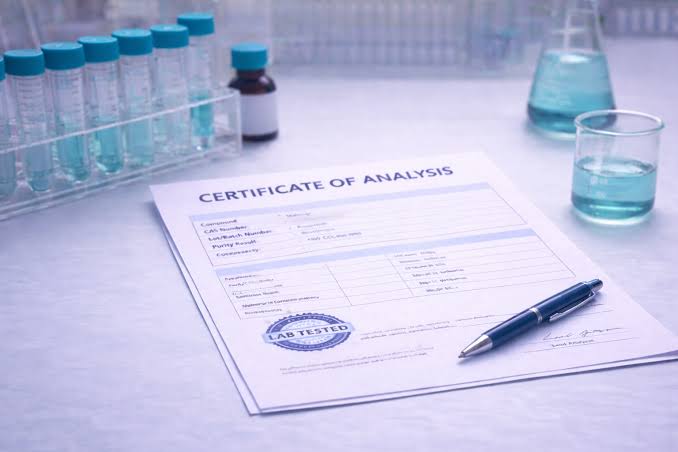
- Lot linkage. A lot number that matches the packing list and the certificate of analysis. Our CoA, MSDS and phytosanitary guide sets out how those documents fit together.
Tie the report to the specification in the purchase agreement. Our guide to quality testing for Indian herbal ingredients lists the other tests a buyer should require.
What We Could Not Confirm
- Limits for any herb. The GB register and the EU pesticides database are interactive, and we could not run lookups for individual herbs. No herb-level limit appears on this page.
- GB Article 20. We read Article 20 in the EU text. We did not read the GB version, so we cannot say how GB applies processing factors to dried herbs.
- Enforcement at the GB border. We did not confirm which authority tests for MRL compliance and how it treats dried material.
- Border list detail. We read the entries for India through summaries of SI 2025/1162 and of the two EU amending regulations. We give no frequencies, and the Scotland and Wales instruments were not checked.
- The advocacy briefing. PAN UK’s figures on GB and EU differences were not checked against the register.
- Northern Ireland in practice. We read HSE’s guidance only, not how it applies to an ingredient supply chain.
Working With Ayris Global
If you are a UK or EU buyer writing a specification for an Indian herbal ingredient, set out the herb, form, destination and target use on our for buyers page, or write through the contact page. If you are an Indian producer asked for a GB-specific lot report, start on the for suppliers page.
Ready to specify your order? Visit the for buyers page or contact Ayris Global.
Frequently Asked Questions
Are GB pesticide residue limits the same as EU limits for Indian herbs?
Not always. Great Britain adopted the EU limits as its own, and HSE says they stay valid until amended. HSE also says GB and EU limits may become different over time, and it adopts Codex limits on its own conditions. Check each substance in the GB register rather than assuming a match.
What limit applies when no specific MRL exists?
Both the EU text and the GB register end at 0.01 mg/kg. GB first applies a substance-specific default from Part 5 of its register where one exists, and the EU can fix different defaults for listed substances. Ask the lab to report each substance with a limit of quantification at or below 0.01 mg/kg.
Which limits apply to a shipment going to Northern Ireland?
HSE says EU MRLs apply to food and feed produced in, or imported into and marketed within, Northern Ireland. GB goods moved under the Northern Ireland Retail Movement Scheme can be marketed there under GB MRLs. Ask the buyer where the finished goods will be sold.
Can one lab report cover both GB and EU buyers?
One test can serve both if the panel covers the substances in each register and reports limits of quantification low enough for the stricter limit of each pair. The comparison is still made separately against each register, so the report should state which registers it was read against and the date.
Where do I check the current limit for a herb?
For Great Britain, use the GB MRL Statutory Register kept by HSE. For the EU, use the EU pesticides database. Both are interactive, so we give no per-herb figures here. Record the date you checked, because limits are amended.